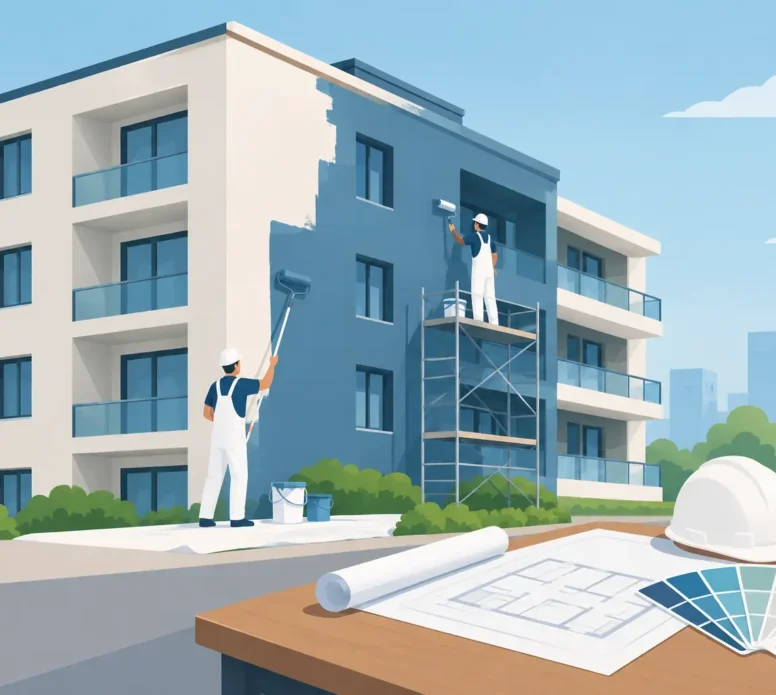
A strata repainting example is most useful when it shows more than fresh paint. For a shared property, the visible transformation matters, but so do the decisions behind it: identifying damaged surfaces early, keeping residents informed, protecting common areas and sequencing work so daily life can continue with minimal fuss.
Consider a mid-sized coastal unit complex with two residential buildings, external stairwells, balustrades, eaves, rendered walls and timber entry features. The paintwork is faded and chalky on the sunny elevations, while shaded areas have mould staining. A few residents have also noticed peeling paint around windows and corrosion beginning on metal handrails.
This is not simply a matter of choosing a new wall colour. It is a maintenance project with presentation, safety and long-term protection all tied together.
The first step is a careful site inspection. Before a scope is confirmed, the contractor should look beyond the obvious faded areas and assess the condition of each substrate. Render, fibre cement, timber, metal and previously painted masonry can all require different preparation and coating systems.
On this example property, the inspection finds that most external walls are sound, but the western side has widespread chalking from UV exposure. Several eaves have failed paint where moisture has entered at joints, and a small number of timber trims show early weathering. The handrails need rust treatment before recoating, rather than paint applied over corrosion.
This level of inspection helps the strata committee understand what is cosmetic and what needs attention to prevent bigger repair work later. It also produces a clearer scope for owners. Vague descriptions such as “paint exterior” can lead to uncertainty once work begins. A detailed scope should identify the areas to be coated, the preparation required, exclusions, access needs and the intended finish.
At this complex, the repainting programme begins with washing down external surfaces to remove salt residue, dirt, cobwebs and mould. On the Coffs Coast, moisture and coastal exposure can make cleaning and mould treatment especially important. Painting over contamination may look acceptable briefly, but it compromises adhesion and can allow staining to return.
After cleaning, the team scrapes loose material, sands failed edges to a sound transition and fills cracks or minor surface imperfections where appropriate. Damaged sealant around selected windows is removed and replaced. Rusted handrail sections are mechanically prepared, treated and primed with a suitable system before their finish coats are applied.
The worksite also needs protecting. Entry paths, garden beds, vehicles and shared walkways are considered before work starts. Drop sheets, masking and regular clean-up are not optional extras on a strata site. They are part of treating residents and the property with care.
The committee wants the complex to feel lighter and more current without making it look out of place. Rather than selecting colours from a small printed swatch alone, they review larger sample areas in different parts of the site. Morning sun, afternoon heat and deep shade can make the same colour appear quite different.
A warm off-white is selected for the main rendered walls, with a softer charcoal-grey for balustrades and a muted timber tone for feature elements. The combination gives the building definition without turning each elevation into a separate design statement.
For strata properties, colour selection needs to balance personal preference with consistency. Owners may have different tastes, but common-property colours should support the whole building, suit its surroundings and remain practical to maintain. Very dark external colours, for example, can create a striking look but may show dust, salt residue or sun fading more readily on exposed surfaces. Pale colours can brighten enclosed walkways, yet they may need more frequent cleaning near gardens or busy entry points.
It depends on the building, its orientation and how the common areas are used. The best choice is usually one that looks considered on day one and remains manageable over the years ahead.
A well-managed strata repaint is rarely completed by treating every surface at once. In this example, the work is staged building by building. Notices are issued before each section begins, advising residents where access may be restricted, when windows should remain closed and which parking spaces need to be kept clear.
External stairwells are planned carefully so residents retain safe access. Where a walkway or entry needs to be temporarily affected, the crew coordinates the timing and puts suitable controls in place. The goal is to avoid surprises, particularly for residents with mobility needs, tenants moving in or out, and trades already booked to attend the site.
Weather also influences the programme. Exterior coatings need suitable conditions to cure properly, and wet weather can change the sequence. A realistic plan allows for this rather than rushing paint onto damp surfaces just to meet an arbitrary date. Clear updates matter here. Strata managers and committee representatives should know what has been completed, what is next and whether conditions have changed the schedule.
Good communication also reduces the number of individual queries reaching the committee. When residents understand the purpose, timing and expected impact of the work, the project tends to run more smoothly for everyone.
Once the final coats are complete, the difference is immediate. The complex appears cleaner, more cohesive and better cared for. Freshly painted eaves and trims sharpen the building lines, restored handrails improve the presentation of common areas, and the updated colour scheme gives the property a stronger first impression for residents, visitors and prospective tenants.
The less visible outcome is just as valuable. Properly prepared and coated surfaces are better positioned to withstand sun, rain and coastal moisture. Addressing mould, chalking, failed paint edges and early corrosion before repainting helps extend the useful life of the coating system.
Before demobilising, the contractor should walk through the site with the nominated strata representative. This is the time to check completed areas, note any touch-ups, confirm that overspray and debris have been removed, and make sure common spaces are left tidy. A final inspection is not about finding fault. It is about ensuring the job matches the agreed scope and the standard the property deserves.
A useful proposal should make it easy to see how the job will be managed, not only what will be painted. Ask how surfaces will be inspected and prepared, how mould or corrosion will be dealt with, and whether different materials have been allowed for in the scope.
It is also sensible to ask about resident communication, access arrangements, protection of gardens and cars, daily site clean-up, and the process for handling weather delays or unexpected substrate issues. These practical details are often what separate a smooth project from a disruptive one.
For older complexes, it may be worth coordinating repainting with gutter repairs, timber maintenance, pressure cleaning or other planned works. Completing compatible maintenance in the right order can prevent newly painted surfaces being disturbed soon afterwards. The right sequence depends on the building condition, but it is always easier to plan it before crews arrive.
A thoughtful strata repaint does more than refresh a façade. It gives the committee a clear path from inspection to completion, while giving residents confidence that their shared property is being looked after properly. If your complex is showing the early signs of wear, a detailed on-site assessment is a practical place to start.