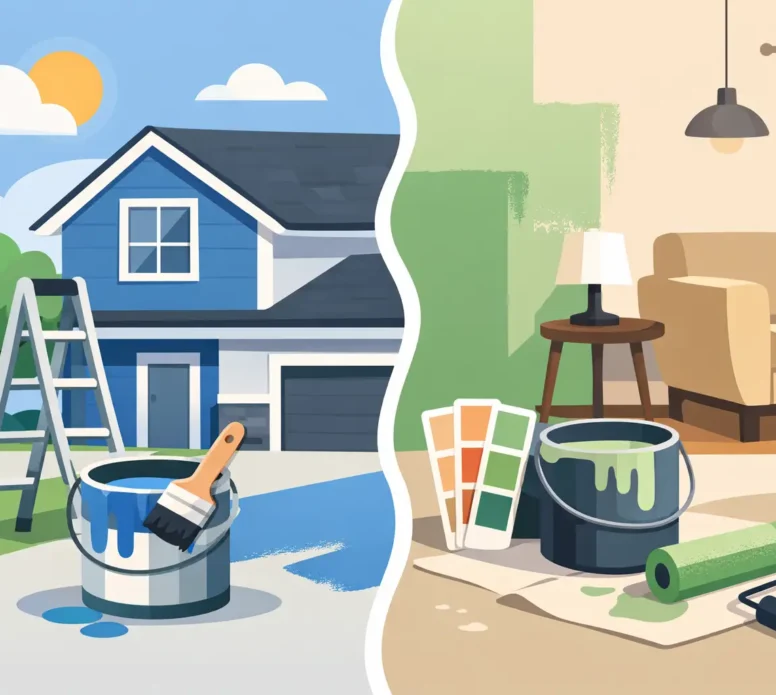
A fresh coat can make a room feel new or give a weathered façade a lift, but paint is not interchangeable. When people ask, “what is the difference between exterior paint and interior paint?”, the short answer is that each coating is designed to handle a completely different environment. Using the wrong one can mean early fading, cracking, poor washability or a finish that simply does not last.
For homes around Coffs Harbour, that distinction matters even more. Coastal moisture, strong sun, salt in the air, wind-driven rain and mould pressure all place real demands on exterior surfaces. Indoors, the priorities shift towards appearance, cleanability, indoor air quality and a finish suited to everyday living.
The main difference is in the ingredients and performance qualities built into the coating. Exterior paint is made to expand and contract with changing temperatures, resist ultraviolet light, shed moisture and stand up to weather. Interior paint is made to cure to a smooth, attractive finish that resists scuffs, marks and regular cleaning without releasing unnecessary odours or emissions inside the home.
They may look similar in the tin, and both may be available in familiar whites and colours, but their resins, additives and sheen options are formulated for different jobs. Paint works as a system too: the right primer, surface preparation and topcoat need to suit the material and the conditions it will face.
Exterior coatings need flexibility. Timber weatherboards, fascia boards, eaves and metal surfaces can expand, contract and move as temperatures and moisture levels change. A quality exterior paint film has enough elasticity to move with the substrate rather than becoming brittle and splitting.
It also contains additives that help resist sun damage, moisture and biological growth. UV exposure is particularly hard on dark colours and unprotected surfaces. Over time, the sun can break down inferior coatings, causing chalking, fading and loss of protection. On the NSW coast, persistent dampness and shade can also create conditions where mould and mildew take hold, especially on southern walls, eaves and sheltered verandahs.
Exterior paint is generally formulated to release moisture vapour while resisting liquid water from rain. That balance is important. If moisture is trapped behind the coating because the surface was not prepared or primed properly, paint can blister, peel or flake regardless of how good the topcoat is.
Interior walls face a different kind of wear. They are touched, bumped, splashed and cleaned. Hallways collect scuff marks, kitchens deal with grease and steam, and children’s rooms often test the limits of even the toughest finish. Interior paint is designed to provide good coverage, a consistent sheen and practical washability.
Many interior products are also lower in volatile organic compounds, known as VOCs, than exterior coatings. This helps reduce odour and supports a more comfortable indoor environment during and after painting. Ventilation is still sensible while paint dries, but interior formulations are developed with occupied spaces in mind.
The finish is another key difference. Interior paints are commonly available in flat, low-sheen, satin and semi-gloss options. Flat paint can soften the look of minor wall imperfections, while low-sheen and satin finishes offer more cleanability for busy areas. Semi-gloss is often a practical choice for trims, doors, skirting boards and some wet areas because it is tougher and easier to wipe down.
It can be tempting to use leftover exterior paint on an internal wall, particularly if the colour is a good match. It is rarely the best choice. Exterior coatings can contain stronger additives for mould, mildew and weather resistance that are not necessary indoors. They may also have a different odour profile and may not deliver the smooth, washable finish expected on internal plasterboard or timberwork.
Exterior paints also remain more flexible by design. That is useful on moving exterior substrates, but not necessarily ideal for a crisp interior finish. A purpose-made interior product will usually look better on walls and trims, be easier to maintain and better suit the conditions inside the home.
There are exceptions for specialist areas. A laundry, bathroom, garage or enclosed outdoor room may need a coating selected for higher moisture, cleaning or ventilation demands. The right answer depends on the surface, how the room is used and whether there is an existing issue such as mould or staining.
Interior paint can fail quickly when exposed to the elements. It is not designed for direct sunlight, rain, temperature swings or extended dampness. On an exterior wall, it may fade, crack, soften, chalk or peel much sooner than an exterior system.
Even protected outdoor spaces are not automatically suitable for interior paint. A covered patio, porch ceiling or verandah might avoid direct rain, but it still experiences humidity, changing temperatures and airborne salt or moisture. Eaves and soffits also need coatings suited to exterior exposure, particularly where ventilation is limited or mould has been present.
If a surface looks sheltered, it is still worth considering what it faces over a full year – summer heat, heavy coastal rain, early-morning condensation and seasonal wind. That practical assessment is often more useful than deciding based on whether the area is technically under a roof.
Choosing the correct paint is only half the job. Paint needs a sound, clean and properly prepared surface to bond well. Skipping preparation is one of the most common reasons a new finish fails early.
For exterior work, preparation can involve pressure cleaning, mould treatment, scraping loose paint, sanding rough edges, repairing damaged timber, filling gaps, treating rust and applying the appropriate primer. Old coatings need to be checked closely. If paint is lifting because moisture is getting in behind it, simply painting over the top will not solve the underlying problem.
Interior preparation is usually more focused on cleaning, patching dents and holes, sealing stains, sanding repairs and caulking gaps around trims. Water stains, smoke marks, tannin bleed from timber and previous mould growth may require specialist primers before the finish coats go on. Otherwise, the stain can work its way back through even a freshly painted wall.
The surface itself also changes the approach. Plasterboard, rendered masonry, brick, fibro, timber, metal and previously painted surfaces all need compatible products. For example, bare timber may need a primer that controls tannin bleed, while metal requires thorough rust treatment and a suitable anti-corrosive coating.
Sheen affects both appearance and maintenance. Higher-sheen finishes reflect more light and are generally easier to clean, but they also show surface imperfections more readily. Lower-sheen finishes are more forgiving on broad walls, although they may be less suitable in areas that receive constant handling or splashes.
Inside, a practical combination is often low-sheen on walls and a more durable semi-gloss or satin finish on doors, trims and skirting boards. Bathrooms, kitchens and laundries need particular attention because steam and regular cleaning can wear an unsuitable coating.
Outside, the choice depends on the substrate and desired look. Low-sheen finishes can work well on weatherboards and rendered walls, while gloss or semi-gloss may suit trims, doors and metalwork. Dark exterior colours can look striking, but they absorb more heat and can make timber movement or surface imperfections more noticeable. On older homes, colour selection should consider both the building material and its exposure.
A paint decision becomes more involved when there is widespread peeling, recurring mould, water damage, timber rot, rust, chalky render or uncertainty about previous coatings. These are not issues to hide under another coat. They need to be identified and addressed so the new paint system has a fair chance of lasting.
This is especially relevant for strata properties, commercial premises and older homes where several surfaces may need coordinated maintenance. Planning the sequence of cleaning, repairs, mould remediation, priming and painting helps avoid rework and keeps the property looking cared for throughout the project.
At Harbour Painting Solutions, the focus is on looking at the whole surface condition rather than treating paint as a quick cover-up. A well-prepared, correctly specified finish protects the building as well as improving its presentation.
Before opening a leftover tin, consider where the surface sits, what it is made from and what it has to withstand each day. The right paint may be only one part of the job, but it gives careful preparation and quality workmanship the protection they deserve.